How to measure for curtains
You need four numbers and a metal tape. Measure the window width from the outside edge of the trim to the other outside edge. Then, from the floor, measure up to the top of the trim and down to the sill. Last, floor to ceiling, or to the bottom of the crown molding if you have one. Measure in two or three spots: floors and ceilings are rarely level, and the shortest number is the one that counts.
For the rod, add 8 to 12 inches to each side of the window width, and mark the height with a strip of painter's tape before you drill. Don't measure the old curtains. They were probably the wrong size, which is why you're here.
Standard curtain lengths (curtain length chart)
Ready-made panels come in a handful of lengths, and each one lands at the floor with the rod at one height. Here's that height for each length, half an inch off the floor. Nudge the rod an inch or two to match and you skip the hemming.
| Length | Rod top, grommets | Rod top, rings | |
|---|---|---|---|
| 63 in (160 cm)Short windows, or to the sill with the rod above the frame | 62½ in | 66 in | Short windows, or to the sill with the rod above the frame |
| 72 in (183 cm)Short walls, attic and basement windows | 71½ in | 75 in | Short walls, attic and basement windows |
| 84 in (213 cm)Rod just above a standard window under 8 ft ceilings | 83½ in | 87 in | Rod just above a standard window under 8 ft ceilings |
| 95 or 96 in (241 cm)Rod hung high under 8 ft ceilings (96: an inch higher) | 94½ in | 98 in | Rod hung high under 8 ft ceilings (96: an inch higher) |
| 108 in (274 cm)Rod right under a 9 ft ceiling, just touching the floor, or high under 10 ft ceilings | 107½ in | 111 in | Rod right under a 9 ft ceiling, just touching the floor, or high under 10 ft ceilings |
| 120 in (305 cm)Ceilings over 10 ft, tall windows | 119½ in | 123 in | Ceilings over 10 ft, tall windows |
| 132 in (335 cm)11 ft ceilings and up | 131½ in | 135 in | 11 ft ceilings and up |
| 144 in (366 cm)Two-story rooms; past this, curtains are made to measure | 143½ in | 147 in | Two-story rooms; past this, curtains are made to measure |
Rod pockets sit about half an inch higher on the rod than grommets, back tabs half an inch lower: move the rod by that much. Shorter panels exist too, at 24, 30, 36, 45 and 54 inches, for cafe curtains and sill length. Most panels are 42, 52 or 54 inches wide, and extra-wide ones around 100.
How high to hang curtains
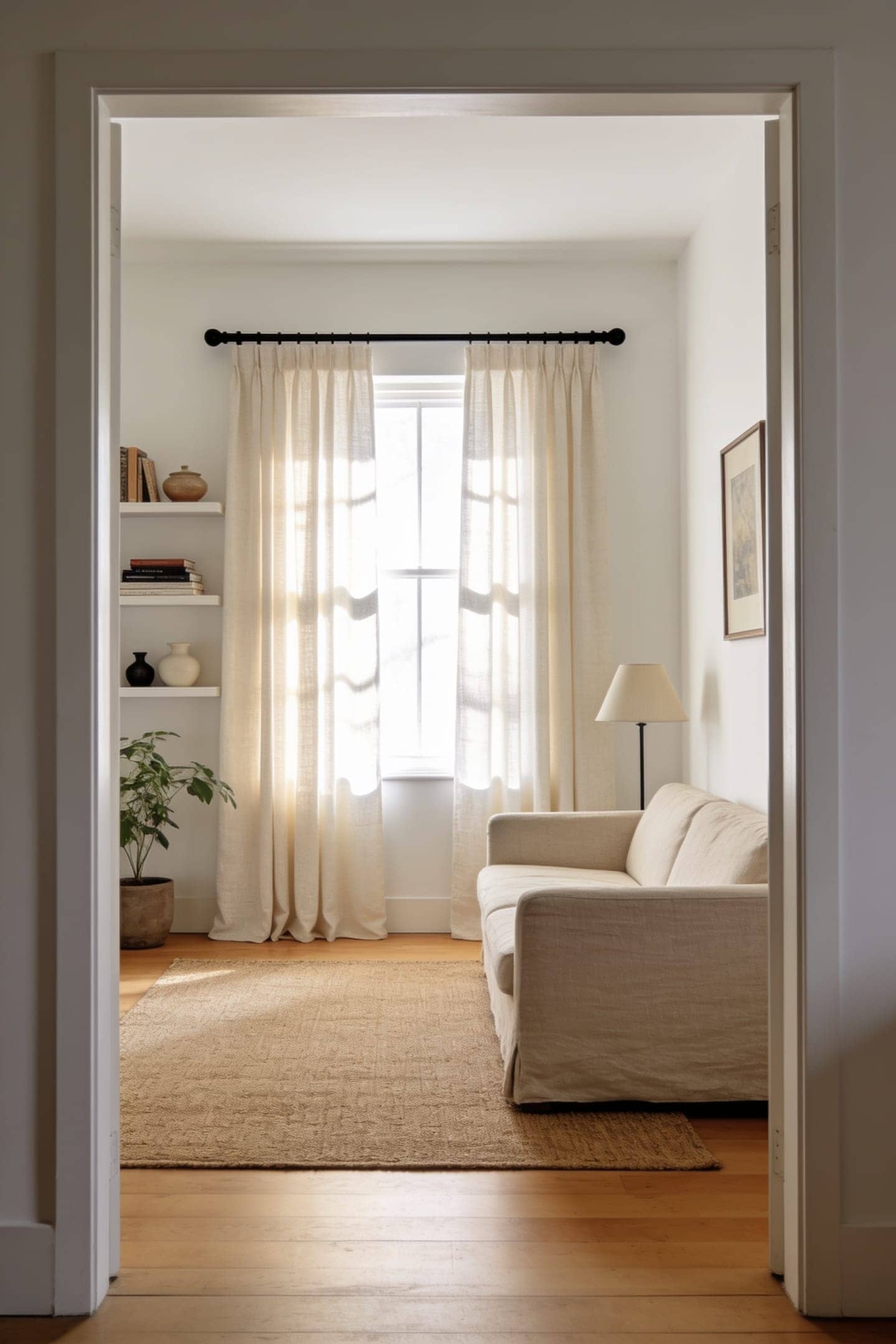
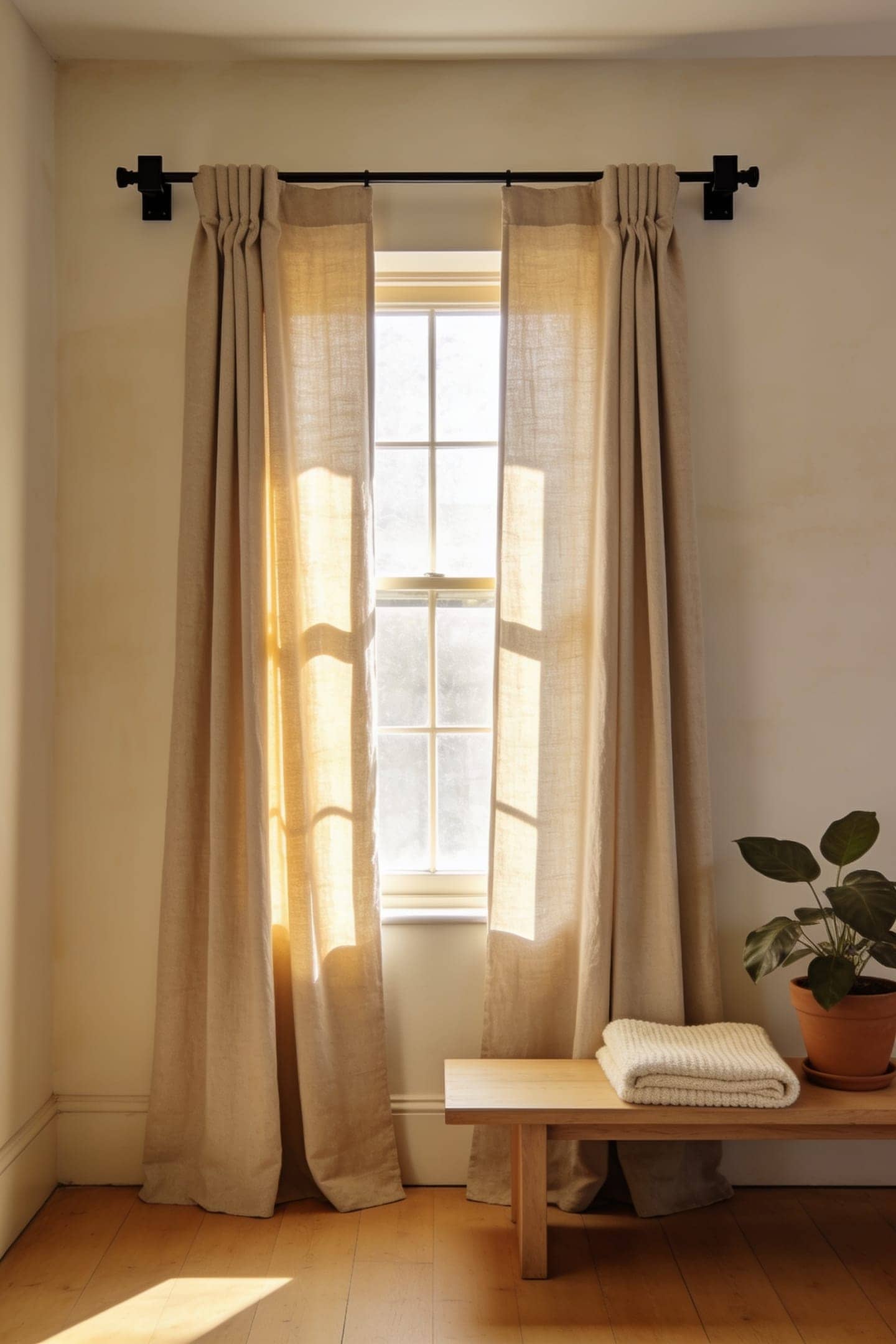
Higher than you think. The rod should sit at least 4 inches above the window, and 8 to 12 inches is a safe default. In most rooms it looks best about two-thirds of the way to the ceiling. That one move makes a standard window look custom, and it costs nothing. Here's what that gives with a standard window at each ceiling height:
| Ceiling | Top of the rod | Buy, grommets | No hemming | Buy, rings |
|---|---|---|---|---|
| 8 ft (96 in)window top at 82 in | 94½ in (7'11") | 95 in | Same | 95 in, hemmed 6 in, rod at 92 in |
| 9 ft (108 in)window top at 84 in | 100 in (8'4") | 108 in, hemmed 7½ in | 96 in, rod at 96 in | 96 in, rod at 99½ in |
| 10 ft (120 in)window top at 96 in | 112 in (9'4") | 120 in, hemmed 7½ in | 108 in, rod at 108 in | 108 in, rod at 111½ in |
How wide should curtains be, and how many panels
Width is where cheap curtains give themselves away. The panels together should measure about twice the rod, and the rod runs 8 to 12 inches past the window on each side so the open curtains sit on the wall, not over the glass. With standard 52-inch panels:
| Window | Rod | Adjustable rod | Panels | Full look |
|---|---|---|---|---|
| 24 in | 40 in | 28 to 48 in | 2 (2.6x) | 2 |
| 31 in | 47 in | 36 to 72 in | 2 (2.2x) | 2 |
| 36 in | 52 in | 36 to 72 in | 2 (2.0x) | 2 |
| 48 in | 68 in | 48 to 84 in | 2 (1.5x) | 4 |
| 60 in | 80 in | 66 to 120 in | 4 (2.6x) | 4 |
| 72 in | 92 in | 66 to 120 in | 4 (2.3x) | 4 |
| 96 in | 120 in | 72 to 144 in | 4 (1.7x) | 6 |
| 120 in | 144 in | 120 to 170 in | 6 (2.2x) | 6 |
What size curtain rod do you need
Window width plus 16 to 24 inches. Buy an adjustable rod whose range puts your length in the middle, not at the very end, where a telescoping rod is weakest. Once it's longer than 48 inches it needs a center bracket, and past 90 inches two, or it sags. A 1-inch rod holds most curtains; my budget curtain rod picks are all at least that.
How the calculator decides
- Rod: 8 in past the trim on windows up to 36 in, 10 in up to 72 in, 12 in beyond.
- Height, hung high: two-thirds of the way from the window to the ceiling, at least 10 in above the window, at most 4 in under the ceiling. Hung above the frame: 10 in, kept between 4 and 12.
- Hem: just above the floor means 0.25 to 1 in of air, a break is 1 to 2.5 in on the floor, a puddle 3 to 7 in, below the sill about 4 in.
- Where the curtain sits on the rod: grommets 1 in above the top of the rod, rod pockets 1.5, back tabs 0.5, rings and clips 2.5 in below.
- Then it picks the stock length that lands in that window with the rod moved least. Hung high, it would rather hem than drop the rod more than 3 in.
- Panels: the number of pairs closest to the fullness you pick, measured on the rod.
Before you buy
Put a strip of painter's tape on the wall where the top of the rod will go, and look at it from across the room. It costs nothing and it catches a rod that's too low before the holes are in the wall. Then check the listing: plenty of panels are sold one at a time, so "$25" is often half a pair.
Once you know the size, my picks for living room curtains and bedroom curtains are a good place to start. Pick the length on the listing before you pick the color.
Questions people ask
How long should curtains be?
Long enough to reach the floor from wherever the rod is, with about half an inch of air underneath. That's the version that looks finished and still vacuums easily. Touching the floor reads more tailored, an inch or two of break looks relaxed, and a puddle only works in a room nobody walks through. Sill length is for kitchens, window seats and anything over a radiator.
How high should curtains be hung from the floor?
The bottom should end about half an inch above the floor. For the rod itself, see the next question: it goes high above the window, and the curtain length follows from it.
How high should you hang curtains?
At least 4 inches above the window, and 8 to 12 inches is a safe default. Hung high looks best: about two-thirds of the way up to the ceiling, or a few inches under it with 8 ft ceilings. In a standard 8 ft room with the window top at 82 inches, the top of the rod goes at about 94½ inches.
What size curtains do I need for 8 ft ceilings?
With grommet curtains, 95 inches, with the top of the rod about 94½ inches from the floor. They end half an inch above it. The 84-inch panels most stores push only reach the floor with the rod sitting on the window frame. With 9 ft ceilings, it's 108 inches hemmed by 7½, with the top of the rod at 100, or 96 inches with no hemming and the rod at 96.
Should I buy 84 or 96 inch curtains?
96 (or 95) for almost every living room and bedroom. 84 only reaches the floor if the rod sits right on top of the window frame, which makes the window look short. To check, measure from where the top of the curtain will sit (about an inch above the rod with grommets, about 2½ inches below it with rings), then take off half an inch. Pick the stock length closest to that number.
What size curtains do I need for a 31 inch window?
A 47-inch rod (8 inches past the trim on each side) and 2 panels, each 52 inches wide. The length depends on the ceiling, not the window: 95 inches under 8 ft ceilings with grommets.
How wide should curtains be?
All the panels together should measure about twice the width of the rod, not the window. A 68-inch rod on a 48-inch window wants about 136 inches of fabric: 2 standard 52-inch panels give 1.5 times, a soft gather, and 4 give a full one. On a 60-inch window it's 4 panels.
How many curtain panels do I need?
Two per window, one each side, is the minimum, even on a narrow window: one panel pulled to the side looks like a shower curtain. Go to four standard panels, or two extra-wide ones, once the rod is wider than about 70 inches.
What size curtain rod do I need?
The window width plus 8 to 12 inches on each side, so the open curtains sit on the wall instead of over the glass. For a 48-inch window that's a 68-inch rod, so a 48 to 84 inch adjustable rod: pick one where your length sits in the middle of the range. Once the rod is longer than 48 inches, add a center support, and a second one past 90.
What measurements do I need for curtains?
Four: the window width from one outside edge of the trim to the other, the height from the floor to the top of the trim, the height from the floor to the sill, and the floor to the ceiling. Measure each in two or three spots and keep the smallest.
How do I work out curtain fabric in meters?
Take the rod width and multiply it by the fullness you want, usually 2. A 68-inch rod is 173 cm, so about 3.5 m of curtain width in total, split between the panels. Switch the calculator to centimeters and it does the rest.
What is the difference between curtains and drapes?
Drapes are lined, heavier and usually floor length; curtains are lighter and come in any length. Online, the two words get used for the same panels, so go by the length, the width and whether the listing says lined or blackout.
Writing about curtains? You're welcome to link to this calculator. Every setting lives in the address, so a link can open on a worked example: a window under 9 ft ceilings, a sliding glass door, a 31-inch window or a wide window with rings. Choosing a rug too? The rug size calculator works the same way.