How to Furnish a Bedroom on a Budget: What to Buy First (and What Can Wait)
The order to buy a bedroom in, what each piece should cost, and what can wait for next month. Room plans drawn to scale, three budgets, one cart.
Some links here are affiliate links. I may earn a small commission at no extra cost to you.
The short answer
Buy a bedroom in the order you'll use it: the mattress first, then the frame, then sheets and something over the window. A good queen mattress is about $200, a solid frame about $55, and the dresser, the rug and the mirror can wait for next month's paycheck.
The rule to remember: Measure the wall first, then buy in the order you'll sleep in the room.
Here's what a queen bedroom comes to, priced from the picks on this site: bare minimum about $430 · the picks I'd make about $780 · finished room about $1,070. See what each one buys, line by line.
The first night, you need five things:
- A mattress. The ones I'd buy go from a cheap hybrid to a cooling one.
- A frame that keeps it off the floor. A metal platform needs no box spring.
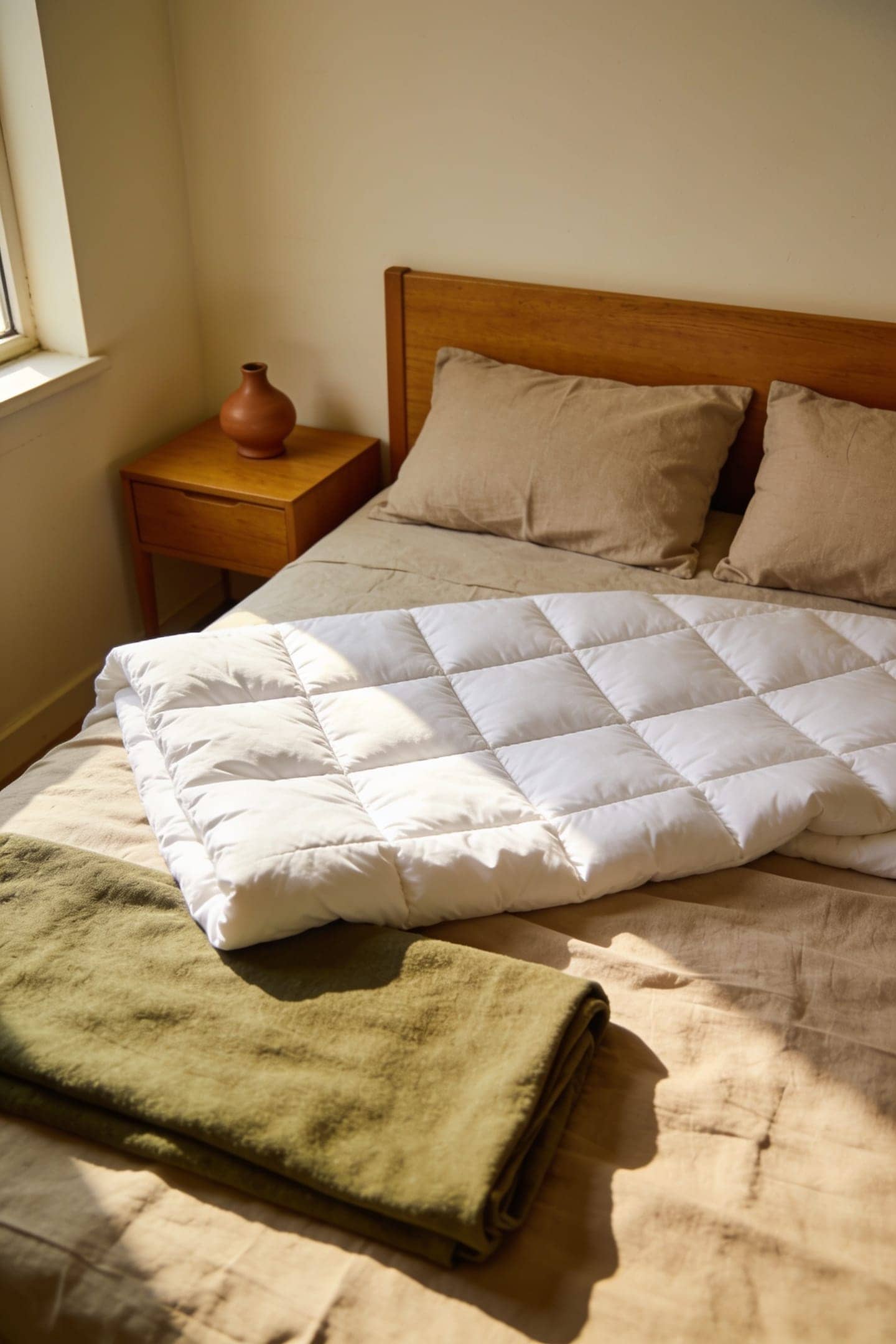
- Sheets and a comforter, or a duvet and its cover. A bedding set puts all of it in one box.
- Two pillows. A good pair costs less than one fancy one.
- Curtains on a rod, with a blackout liner if the window faces east.
Everything else gets bought in the weeks after, in the order below.
What size bed fits your bedroom? Measure first
Three room sizes, drawn to scale from above. Find the one closest to yours before you open a single mattress listing.
Full, 10 × 10 ft room
- Full mattress: 54 in (137 cm) × 75 in (191 cm)
- Bed and two nightstands: 98 in (249 cm) of wall
- Each side of the bed: 33 in (84 cm)
- At the foot: 45 in (114 cm)
- In front of the dresser: 45.4 in (115 cm), an open drawer and room to stand
Queen, 10 × 12 ft room
- Queen mattress: 60 in (152 cm) × 80 in (203 cm)
- Bed and two nightstands: 104 in (264 cm) of wall
- Each side of the bed: 30 in (76 cm)
- From the foot to the dresser: 48.6 in (123 cm)
- In front of the dresser: 45.4 in (115 cm), an open drawer and room to stand
King, 12 × 12 ft room
- King mattress: 76 in (193 cm) × 80 in (203 cm)
- Bed and two nightstands: 120 in (305 cm) of wall
- Each side of the bed: 34 in (86 cm)
- From the foot to the dresser: 48.6 in (123 cm)
- In front of the dresser: 45.4 in (115 cm), an open drawer and room to stand
The three numbers to measure
First, the wall the bed goes against, from corner to corner or corner to door frame. A queen is 60 inches wide, and with a nightstand on each side it takes 104 inches of wall. A full takes 98. A king takes 120, which is an entire 10 foot wall with nothing left over.
Second, the walkway you'll actually use, from the side of the mattress to the nearest wall or piece of furniture. Thirty inches is the clear width of a spot to stand in, so treat it as the minimum. Thirty-six is a comfortable path, the width a wheelchair needs.1
Third, the doors and windows. Mark where the closet door swings, where the radiator sits and which window you'll want curtains on. Keep the headboard clear of the window if you can, so the curtains close all the way.
Twin, full, queen or king: the room each one needs
A queen in a 10 × 12 room is the right bed for most people. Look at the middle plan: 30 inches on each side, and enough room at the foot to pull a drawer all the way out and still stand in front of it. Put a king in that same room and you're down to 22 inches a side, 8 short of the 30 a spot to stand in needs.
A full fits a 10 × 10 room with space to spare, and it's the right bed for one person in a small room. A twin (38 by 75 inches) is for kids, bunks and daybeds.
Living in a studio, on a tight budget? Buy the full. In a studio the bed usually goes in a corner with one long side on the wall, and a full takes 54 by 75 inches of floor against 60 by 80 for a queen. Those 6 inches of width come out of the walkway, which needs to stay at 30 inches between the bed and the sofa or the table. Measure from the wall the bed goes against to the nearest piece of furniture: under 84 inches, only the full leaves you that walkway. A queen is worth it in a studio only if two people sleep in it and that measurement is 90 inches or more.
Building codes generally require a bedroom to be at least 70 square feet and 7 feet across in every direction. So any room that legally counts as a bedroom can take a full. A dresser on top of that needs about 45 inches of clear floor in front of it, for the open drawer and you.
Thinking about a rug as well? The rug size calculator draws the bed and both nightstands in your room, so you check the layout and the rug in one go.
What about a California king, or an Alaskan king?
A California king is 4 inches narrower and 4 inches longer than a king (72 by 84 against 76 by 80). It suits tall sleepers and long narrow rooms, and the sheets aren't interchangeable. Every measurement sits side by side in the bedding size chart, including the ones people mix up.
The Alaskan king is 108 by 108 inches, a 9 foot square. Mattress makers sell it, but it isn't one of the standard sizes, so sheets, frames and covers are mostly special orders. On a budget, skip it.
The mattress: where to buy it and what it should cost
Most people save on the mattress so they can spend on the bed that shows. It's backwards: you sleep on the mattress, and you only look at the frame. A good budget queen costs about $200, and it's the one line on this page worth pushing your budget up for.
Where to buy a cheap mattress
Online, in a box. The bed-in-a-box brands that make the good cheap mattresses sell directly on Amazon, so every size and firmness sits side by side, with the layers and the warranty written on the listing. A store lets you lie on a floor model first, and the price includes the showroom.
A cheap mattress in a box is as safe as an expensive one. Every mattress made or imported for sale in the US since July 2007 has to pass the same federal open-flame test, whatever it costs and wherever it's sold.2
What separates a good cheap mattress from a bad one is written on the page. Look for CertiPUR-US foam, no fiberglass, 10 inches or more for an adult and a real warranty, and skip any listing that doesn't say what's inside.
How much a mattress costs, by size
The cheapest queen with real pocket springs runs about $160, and my pick for most people is the Zinus Green Tea at about $200.
A full is often only a little cheaper than the same model in queen, so price the queen before you settle on 6 fewer inches. A king tends to sit closer to the queen price than you'd guess, so price it too before you rule it out.
The mattress roundup has the price range for every size from twin to king, and the one I'd buy at each. Sleep hot? The cooling pick there is the SweetNight CoolNest at about $400, worth it only if heat is what wakes you up.
Foam or springs, soft or firm
Memory foam is the cheapest and the quietest, and it hugs. It can sleep a little warm. A hybrid puts foam over springs, so it bounces more and breathes better. Its edges are firmer too, so the side doesn't sink when you sit on it.
Firmness follows how you sleep:
- On your side: medium to medium soft, so your shoulder sinks in.
- On your back: medium firm.
- On your stomach: firm, so your hips stay level.
Two people who disagree? Buy medium, or a notch firmer if you're unsure.
What if you hate it? Trials and returns
Buy from a listing that spells out a trial. The Siena gives you 180 nights and the Vesgantti 120, longer than any store will let you lie on a floor model. What a trial means once the mattress is out of its plastic is covered under delivery day, below.
Pillow top, topper or neither?
A pillow top is a soft layer sewn onto the mattress. It feels wonderful in month one and it's the part that flattens first.
A topper does the same job and comes off. If the bed you have feels too firm, a 3 inch gel topper at about $53 fixes it long before you need a new mattress. Thickness, foam types and the difference with a mattress pad are all on the topper page.
The bed frame: platform bed, box spring, or neither?
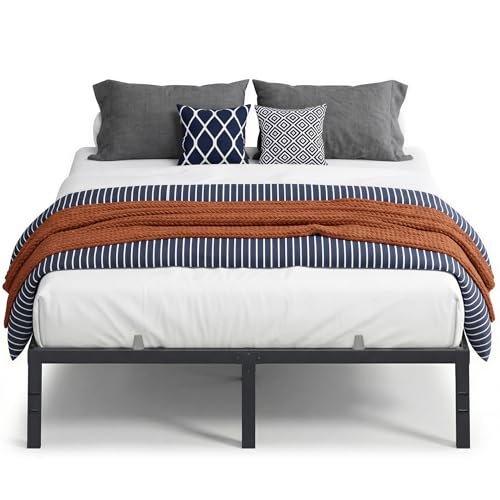
How much does a solid frame cost? The VASAGLE metal platform I'd pick is about $55. Pay twice that and the extra goes into a headboard, not a sturdier frame.
Do you need a box spring?
No, not with a platform frame. A mattress in a box is made to sit straight on slats, as long as they're about 3 inches apart at most. Wider gaps let foam sag between them, which feels like a worn mattress within a year and can void the warranty.
A box spring only earns its place on an old metal rim frame with nothing across the middle. Adjustable bases are a different purchase: whether a mattress can bend on one is written on its listing, so check that before you buy the base.
Platform, panel or upholstered: what you're paying for
A platform frame is legs, rails and slats. It's the cheapest, and on a starter budget it's the right buy.
A panel bed has a flat headboard and often a footboard, in wood or metal. That's where a room starts to look finished. An upholstered bed has a padded headboard you can lean against to read, and it usually sits the lowest of the three, which leaves the least room for storage underneath (clearance, below).
Metal gets you the most strength per dollar. The VASAGLE states 1,100 lb on nine legs, more than the solid wood frame on my list at nearly three times the price. A steel frame with a wood headboard gives you that strength and the look of wood for less.
Two things I wouldn't buy. A folding frame that arrives as a bag of tubes, which is where the squeak reviews live. And a bed with built-in LED strips, which are part of the frame and can't come off.
Why 14 inches under the bed matters more than the headboard
Clearance is the number on a bed frame that does the most work. Here's what each thing needs underneath:
- a standard under-bed bin: 6 to 7 inches;
- a carry-on suitcase: about 12;
- a robot vacuum: about 4.
Fourteen inches takes all three.
Now add the frame and the mattress together, because that sum is what you sit on. A 14 inch frame under a 10 inch mattress puts the top of the bed at 24 inches, right in the range most people find comfortable. A 12 inch mattress on an 18 inch frame puts it at 30, high enough that a shorter person has to climb in.
The upholstered one on my list sits at 7.5 inches. The bin barely fits and the suitcase is out. In a small apartment with a small closet, take the taller frame.
When the headboard comes in
When you're ready for the bed to look like furniture, the headboard is the upgrade that does it, and it comes second after the mattress for extra money. The SHA CERLIN with a wood headboard and footboard runs about $126. It adds 4 inches to the length of the bed, so measure the foot before you order.
The bed frame roundup gives the clearance of all ten, from the 7.5 inch upholstered bed to the 18 inch tall frame.
Delivery day: the mattress box and the frame
Order the mattress and the frame in the same cart, and check the delivery date on both listings before you pay. They're the two heavy boxes, and the bed has to be there the first night.
A mattress in a box can go up three flights with one person carrying it, no truck needed. It's heavy for its size, so slide it on its edge and take the stairs slowly.
Build the frame first
The frame goes together before the mattress comes out of its plastic. The VASAGLE arrives flat with the hardware in the box. The SHA CERLIN with the headboard takes about half an hour and needs no extra tools.
Build it in the bedroom: a queen frame is about 60 inches wide once it's together, and much easier to carry in pieces. Keep the box and the hardware bags until the bed is finished and quiet, since a frame goes back much more easily flat than half built.
Squeaks on the first night? On the VASAGLE, the few reviews that mention noise say it stopped once the center leg was pushed all the way down to the floor. Check every center leg on any frame before you blame the slats.
Unroll the mattress where it will sleep
Where you open the box matters. Once the plastic is off, the mattress starts to expand and gets much harder to move. So carry the roll to the bedroom, set it on the frame, and only then cut the wrap, with scissors pointed away from the cover.
Then give it time:
- The Zinus wants a full day or more to puff up to its full height.
- The Novilla wants about 72 hours to air out and take its full shape.
- The SweetNight wants about three days to fully rise.
- The Ashley Chime can be slept on the first night, with the new-foam smell and the last bit of rise taking a few days.
Open the window while it airs. Put the sheets on once the mattress has its shape, so the fitted corners don't fight it.
Returns, once it's out of the box
A rolled mattress can't be rolled back at home, so once you've cut the plastic, a return goes through the trial on the listing. Keep the order email until the trial runs out.
The old mattress
Plan where the old one goes before the new one shows up. Many cities pick up bulky items on a schedule or by appointment, and the city website says how. California, Connecticut, Oregon and Rhode Island run state mattress recycling programs (Bye Bye Mattress) with drop-off sites.
Wrap the old mattress in plastic or an old sheet before it goes down the stairs, and send it to pickup or recycling rather than to a neighbor.
Bedding: what you actually need on the bed
On a new bed, the first night, you need a fitted sheet, a warm layer on top and two pillows. A soft complete set that lasts costs about $50, and the floor for one that doesn't look cheap is about $30.
The first-night list
- A fitted sheet. The one with the elastic corners. Check the pocket depth against your mattress: a 10 inch mattress wants a pocket of 12 or more.
- A flat sheet, if you like one. It goes between you and the comforter and gets washed more often, so the comforter doesn't have to. Plenty of people skip it.
- A comforter, or a duvet insert in a cover. One warm layer on top. More on which, below.
- Two pillows and their cases. Two queen pillows side by side are 60 inches across, exactly the width of a queen. That's why the bed looks right with two and lopsided with one.
Sizes trip people up more than anything else on this list. The bedding size chart has every sheet, comforter and pillow size by bed, including the ones that run small. A queen blanket, for the record, is about 90 inches wide.
Comforter set or duvet and cover?
A comforter set comes filled and ready, usually with two shams. A duvet cover is a big pillowcase for an insert you buy separately. It costs a little more the first time and less every time after, because you wash a cover and leave the insert alone.
Change the look of your room every couple of years? Go duvet. A good insert costs about $35, and there are warm and cooling ones on the duvet insert page. Rather keep one look for years? A comforter is simpler, and my comforter roundup sorts them into everyday, winter, cooling and luxury picks.
For pillows, the Sasttie pair at about $20 is what I'd put on almost any new bed. The pillow roundup sorts the rest by how you sleep.
Where I don't cut
The fill and the fabric finish. They're what read cheap from across the room: the slick sheen on a polyester set, a comforter that lies flat where it should puff. The shiny set that looked fine in the photo can go flat after its first wash and need replacing within the year.
A matte cotton or a brushed microfiber with real loft looks like it cost more than it did. All my budget bedding sets are matte, from microfiber to linen.
Top floor with no AC? The sheets matter more than anything you put on top of them. Which sheet material to buy breaks down percale, linen and the rest by how hot you sleep, and what thread count does and doesn't tell you.
Curtains: blackout, hung high and wide
Why does a bedroom look unfinished even with nice curtains? Usually because they're too short and hung right at the top of the window frame. The window looks small and light leaks in around the edges.
A good pair costs about $70. Curtains are sold by the panel, and a standard window takes two.
How long and how wide
- Rod width. Run it 8 to 12 inches past the window frame on each side. Open curtains then hang on the wall, clear of the glass, and the window reads bigger than it is.
- Rod height. Hang it about two-thirds of the way from the top of the frame to the ceiling.
- Panel length. On an 8 foot ceiling, that usually means a 95 or 96 inch panel ending just above the floor.
- Panel width. Buy panels that add up to about twice the width of the window, so they gather into folds when they're closed.
The curtain size calculator does all four from three measurements and tells you which stock length to buy, so you never hem a thing.
Why blackout, in a bedroom
A sewn-in liner darkens the room enough to sleep past sunrise. The linen-look blend keeps the texture that makes a cheap curtain look like a better one.
Shift worker, or a streetlight right outside? Go for the full blackout thermal panels at about $25 a panel. The rest of the bedroom curtains, sheers included, are on one page.
Putting up a rod in a rental
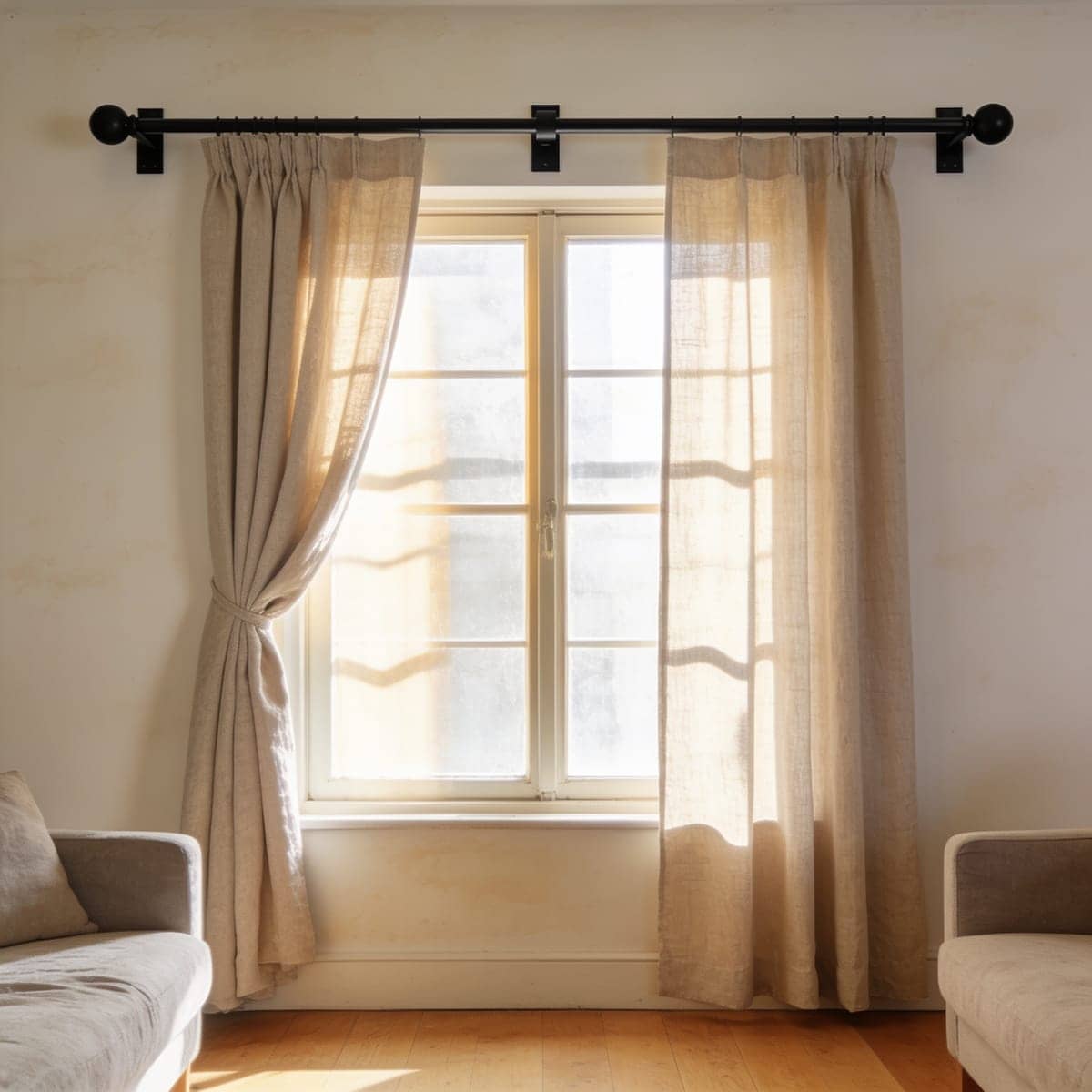
The rod is where a budget window gives itself away. A thin rod bows in the middle under the weight of blackout panels.
A rod with a center support bracket fixes that for about $36. Any span past 48 inches needs that middle bracket. There are more rods here, from small windows to doubles.
The screws are the other weak spot:
- The plastic anchors in the box are what pull out of drywall. Buy a pack rated for 25 pounds or more, or find the stud.
- Worried about the lease? Four small screw holes fill with a dab of spackle on the way out. Most landlords are fine with that, so ask.
- No-drill brackets that tap into wood trim hold light curtains. Blackout panels are too heavy for them.
Next to the bed: a nightstand and a light, no electrician
Renters spend a lot of energy wishing for recessed lights they'll never be allowed to install. You don't need them. A lamp on a nightstand, or a rechargeable sconce where there's no outlet, gives you better light than a ceiling can, because it sits at the height of your book.
The nightstand: height first
Aim for a top roughly level with the top of your mattress, give or take two inches. For most beds, that's a nightstand 24 to 28 inches tall. Too low and you knock the water glass over reaching for your phone. Too tall and the lampshade sits in your eyeline.
Nightstand or end table? Same piece of furniture, different name on the listing. An end table from the living room section works fine beside a bed if its top lands near mattress height.
Width matters less than height. About 22 inches across holds a lamp and your phone, and in a small room a narrower one keeps the path clear.
My pick is a two-drawer wood nightstand at about $80.
Start with one. The second nightstand can wait for months, and an open-shelf one at about $50 holds the alarm clock fine in the meantime. The narrow ones for tight spaces are on the nightstand page.
A light you don't have to wire
On the nightstand, a lamp about 24 to 27 inches tall puts the bottom of the shade near eye level when you're sitting up in bed. The ceramic one on my list costs about $45. The cheap ones have a shiny plastic shade over a base that tips if you brush it, so look for a fabric shade on a heavy base. The rest are in my table lamp roundup.
No outlet near the bed, or no room for a lamp at all? Rechargeable wall sconces stick or screw to the wall with no wiring, and a set of two runs about $47. Mount them about 60 to 66 inches from the floor to the middle of the sconce, close enough to reach from bed. The sconce page sorts them by how long they last on a charge.
Read in bed every night next to someone who doesn't? A small wall reading light at about $16 lights the page and leaves the other pillow dark. Clip-on and gooseneck versions are with the other reading lamps.
Which bulb
A bulb sold as a 60 watt equivalent gives about 800 lumens, plenty for a bedside lamp.3 Pick 2700K, the one labeled soft white or warm white. That amber light suits a bedroom. Daylight bulbs, 5000K and up, read blue and harsh.
No dresser yet? Where your clothes go
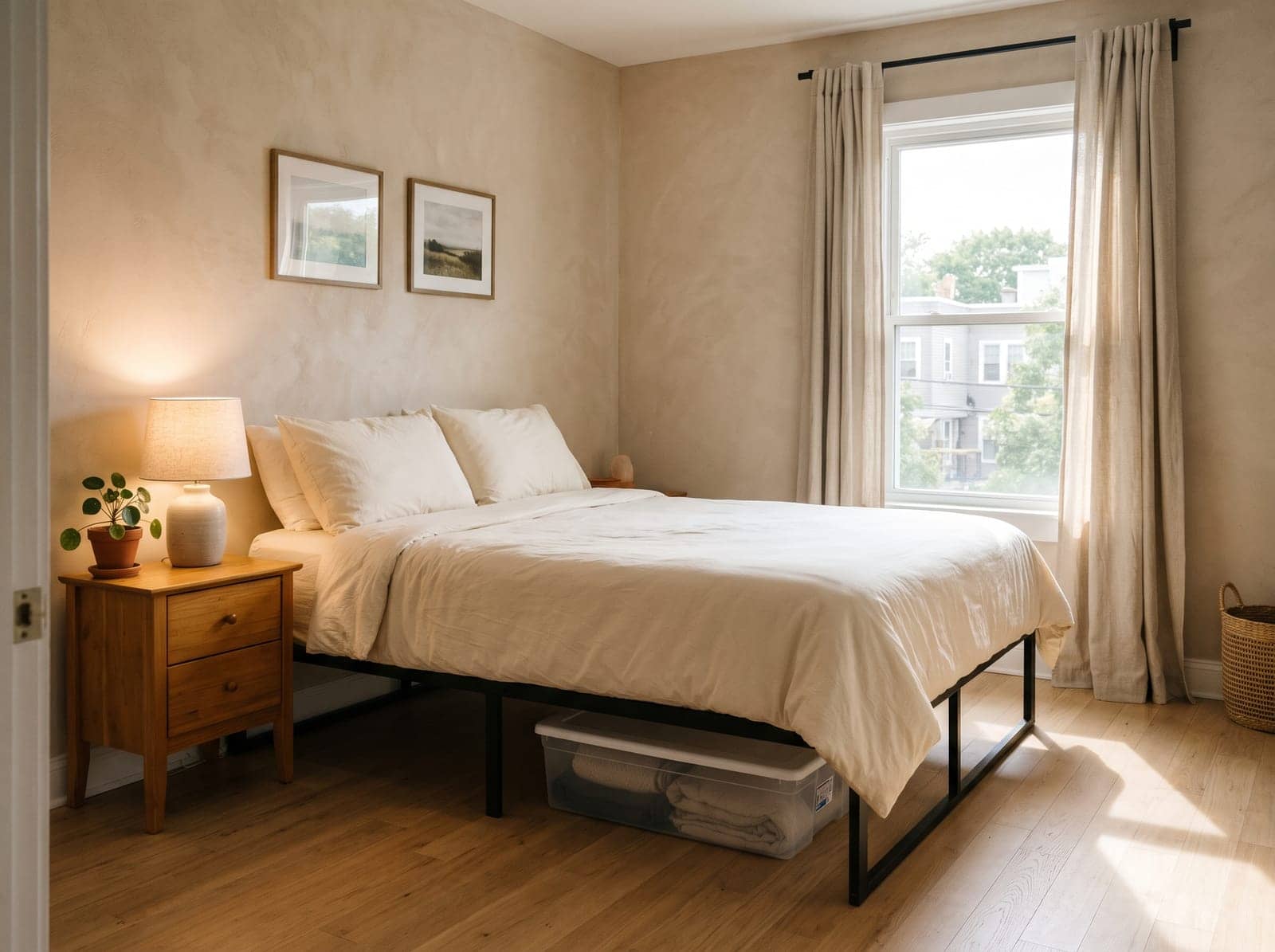
Under the bed. One 66-quart rolling bin holds a season of clothes for about $29. It's 7 inches tall, so it slides under a platform frame like the VASAGLE with room to spare, and the lid opens in two halves so you can grab one sweater without dragging the whole thing out.
What goes under the bed, and what doesn't
Winter sweaters, spare sheets and the shoes you wear twice a year go under the bed.
Everyday T-shirts and underwear stay closer to hand: fabric cubes on a closet shelf, or a couple of woven baskets on the floor, which pass for decor.
Shopping for bins? Skip the ones with no board in the sides, which slump the minute you fill them. All the storage bins I'd buy hold their shape.
Want the most room possible? An 18 inch tall frame like the EMODA leaves space for stacked bins, and in a small apartment it can stand in for a cheap dresser altogether.
When you do buy one
Measure the wall, then take off a couple of inches. A tall chest about 24 inches wide suits a small room. A long low dresser of 47 inches or more suits two people. Depth matters too: 15 inches holds folded sweaters, and under 12 is tight for them.
The kind of dresser matters more than the brand. Fabric drawer towers are light and cheap and fine for socks and T-shirts; the large drawers on the SONGMICS are rated for 22 pounds. Panel drawers on metal glides cost more and slide like real furniture. A tall dresser saves floor; a wide one gives you a top for a mirror and a lamp.
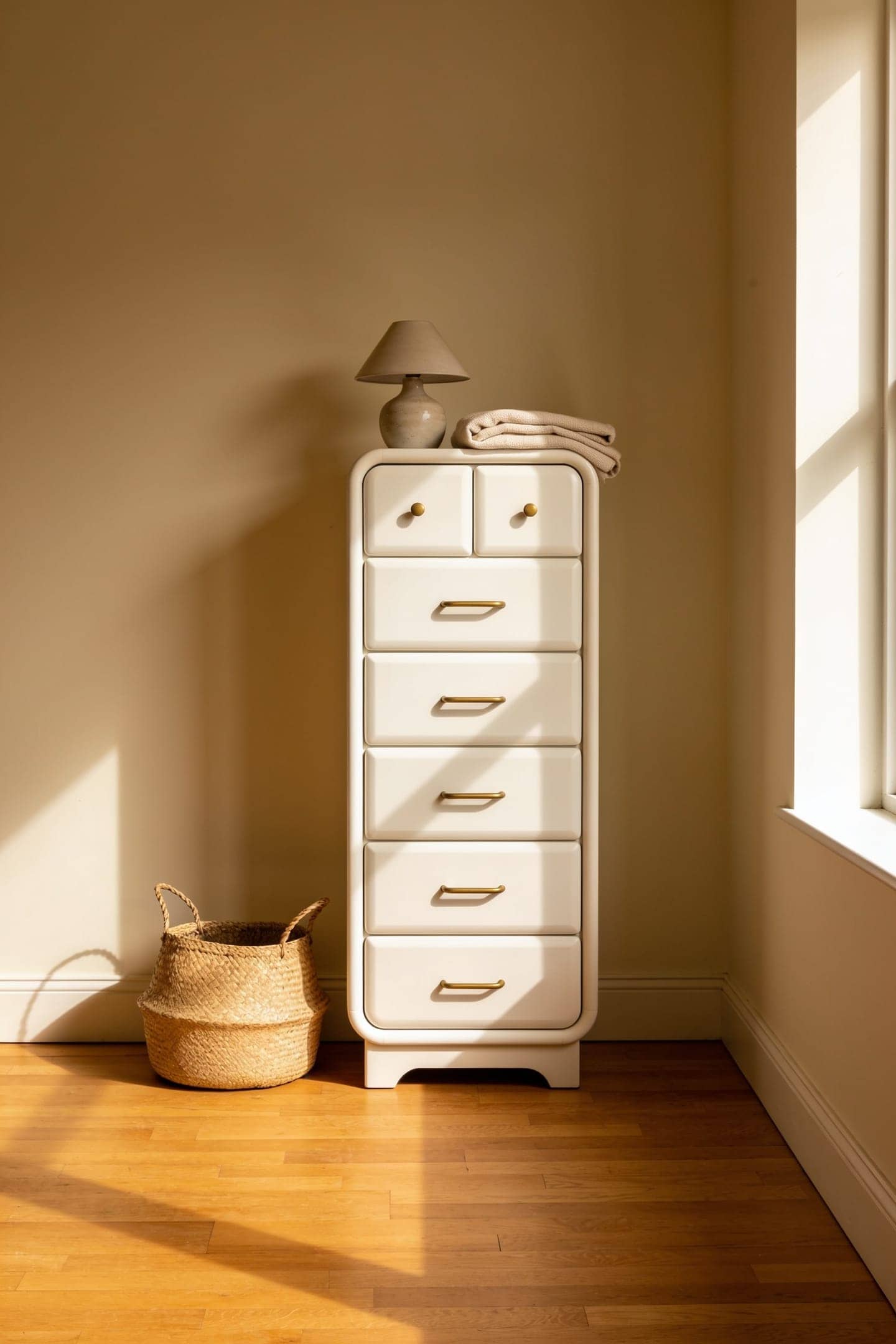
My pick is the Pipleo tall 6-drawer at about $100: 23.6 inches wide, 15.4 deep and 43.3 tall, which covers most wardrobes on very little floor. Tighter budget? The SONGMICS wide 9-drawer costs about $60, and the winter clothes stay in the bin. A small 3-drawer for tiny rooms and one that works under a TV are on the dresser page.
Anchor it, even if it's new
New dressers sold in the US have to pass a tip-over test now, and you still screw the anti-tip strap into the wall.4 The test covers furniture made since late 2023, and the dresser you find on Marketplace may be older.
The strap comes in the box and takes ten minutes to put up, and the hole fills with spackle when you move out.
The rug under the bed: go big or wait
Under a queen, the rug is an 8x10. A 5x7 slipped under the same bed vanishes, and your feet still land on cold floor every morning. A rug that's too small ends up costing more than the right one, because you'll replace it, so settle the size before you look at a single pattern.
Rug sizes by bed, in one line each
- Queen: an 8x10, placed under the lower two-thirds of the bed so it shows on both sides and at the foot.
- King or California king: a 9x12.
- Full or twin: a 6x9 does the same job.
- A 5x7: only across the foot of the bed, sideways, or not at all.
- Two runners: one on each side, for a room too tight for a full rug.
Rooms aren't all 10 × 12, so check yours with the rug size calculator. It draws the bed, the nightstands and the rug at scale and tells you how much floor stays bare at the walls.
Washable, or not
In a bedroom, a rug sees bare feet and very little traffic, so soft wins. The Plush Shag in my budget area rugs is the one you want to step onto in the morning, and in a bedroom it never gets the wear that ruins shag in a living room. Prices in that list are for a 5x7, the shag at about $70. For the 8x10 a queen needs, the washable ones on my list run from about $125 to about $200.
With a dog, a cat or a toddler, washable is the safer bet. The Lahome Moroccan, the cheaper of those two, is thin enough to slide under the bed legs and fold into a large washer. Most of the other washable rugs come in smaller sizes.
On a hard floor, a thin rug under a bed mostly stays put, since the bed legs pin it down. The part that slides is the strip you step onto. If it creeps, a cheap rug pad cut a little smaller than the rug fixes it, and Lahome itself suggests one on very smooth hardwood.
The finishing touches: mirror, throw and pillows
Six thin decorative pillows you pull off and pile on the floor every night don't finish a bed. Two good ones in front of the sleeping pillows do, with a throw folded at the foot.
Pillows: how many, and the insert trick
On a queen: two sleeping pillows, then two shams or two square throw pillows in front.
On a king: two king pillows, which are 36 inches long each, then either two or three square Euro shams behind them (26 by 26) or a couple of throw pillows in front.
Past five pillows, making the bed becomes a chore.
What makes a cheap cover look expensive is the insert under it. Washed linen covers cost about $14 for two, and on a limp polyester insert they look sad and half-empty.
Put them on plump down-alternative inserts one size up, a 20 inch insert in an 18 inch cover, and they stand up like boutique pillows. A set of four inserts runs about $30: two fill these covers, and the other two wait for a second pair of covers when the season changes. Velvet and corduroy covers for that second pair are in the throw pillow roundup.
A throw at the foot
A throw is 50 to 60 inches wide and 60 to 80 long, smaller than the bed on purpose. Fold it in thirds lengthwise and lay it across the bottom third of the bed, or drop it loosely over one corner. The chunky knit at about $32 adds texture to a plain comforter. Sherpa and wool blend versions are on the throw blanket page.
A mirror you'll use every morning
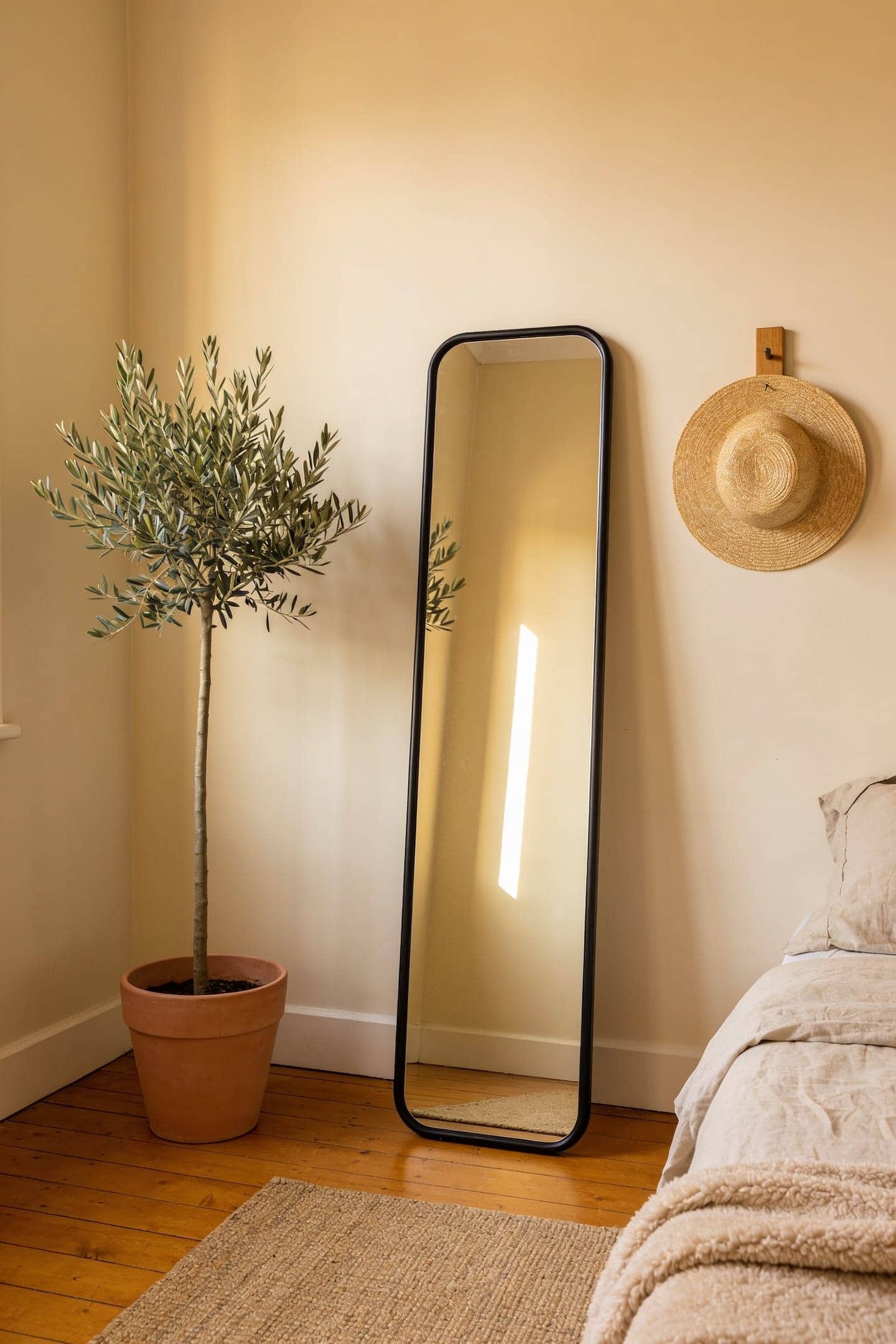
A full-length mirror is the one you'll actually use when you get dressed. Buy real glass, since plastic mirrors warp the reflection.
The BEAUTYPEAK at about $53 is wide, comes on its own stand and needs no holes. No floor to spare? A door mirror hangs over the closet door for about $30. Every one of the full-length mirrors I'd buy is real glass.
Over a nightstand, a small mirror reads as a picture and bounces the lamp light back into the room. The arched mirrors start small enough for that spot. For colors and styles, the bedroom decor ideas are where I put the looks.
How much does it cost to furnish a bedroom?
Here's the whole room at three budgets, line by line.
| Step | Bare minimum | The picks I'd make | Finished room |
|---|---|---|---|
| Mattress | about $160Vesgantti hybrid | about $200Zinus Green Tea | about $200Zinus Green Tea |
| Bed frame | about $55VASAGLE platform | about $55VASAGLE platform | about $126SHA CERLIN wood |
| Bedding set | about $30Microfiber set | about $50Cotton set | about $50Cotton set |
| Pillows | about $20Sasttie, set of 2 | about $20Sasttie, set of 2 | about $20Sasttie, set of 2 |
| Curtains | about $40Greige grommet × 2 | about $70Linen blackout × 2 | about $70Linen blackout × 2 |
| Curtain rod | about $18Basic 1 in rod | about $36Center support rod | about $36Center support rod |
| Nightstand | about $50Open-Shelf Nightstand | about $80Two-drawer wood | about $160Two-drawer wood × 2 |
| Bedside lamp | about $26Mini Accent Lamp | about $45Ceramic Table Lamp | about $55Bedside lamp pair |
| Clothes storage | about $29Underbed rolling bin | about $100Pipleo 6-drawer | about $100Pipleo 6-drawer |
| Rug | Later | about $125Lahome Moroccan 8x10 | about $125Lahome Moroccan 8x10 |
| Mirror | Later | Later | about $53BEAUTYPEAK mirror |
| Throw blanket | Later | Later | about $32Chunky knit throw |
| Throw pillows | Later | Later | about $14Linen covers |
| Pillow inserts | Later | Later | about $30Pillow inserts |
| Total | about $430 | about $780 | about $1,070 |
Queen size. Each price comes from the roundup the step links to; the totals are rounded to the nearest ten.
What your budget buys
- With about $430: the left column. The five first-night things, plus the three you'll miss by the end of the first week: somewhere to put a glass of water, a light you can reach from bed and a bin for your clothes.
- With about $780: the middle column, what I'd buy over the first month or two in this page's order. It upgrades the mattress, the bedding and the curtains, and adds the dresser and the 8x10 rug.
- With about $1,070 or more: the right column. It adds the headboard, the second nightstand and a pair of lamps, then the mirror, the throw and the pillows that make the bed look styled.
- Less than the minimum: buy the mattress, the frame and the bedding first, and use what you already own for the rest.
In between two columns? Start from the left one and move one line at a time to the right, mattress first, frame last. Every line you move is a better version of something you already own. When the money runs out, stop there, since every column already works as a room.
What can wait, and what to use meanwhile
- The dresser. The rolling bin under the bed until you find the right one.
- The rug. Bare floor until you can buy the 8x10.
- The mirror. The bathroom one works for a few weeks.
- The second nightstand and lamp. A stool or a stack of hardcovers for the alarm clock.
- The headboard. A plain wall behind a well-made bed is fine for months.
- The mattress protector. A thin washable layer under the fitted sheet that keeps a cheap mattress from aging fast. Add one in the first month, and wash it with the sheets, dried on low, since high heat cracks a waterproof backing.
The starter kit: what I'd put in my own cart

Mattress
Zinus Green Tea 10 in
The memory foam queen I'd start a bedroom with.
Bed frame
VASAGLE 14 in platform
A metal frame with no box spring needed and room for bins underneath.

Bedding set
Cotton comforter set
Comforter and shams in cotton, the set that looks the least cheap.

Pillows
Sasttie pillows, set of 2
Two queen pillows for the price of one good one.

Curtains
Linen blackout curtains
A linen look with a blackout liner, two panels for one window.
Curtain rod
Center support rod
The rod that stays straight with blackout panels on it.

Nightstand
Two-drawer nightstand
Two drawers and a top wide enough for a lamp and a glass of water.

Bedside lamp
Ceramic table lamp
A ceramic base and a linen shade, warm light by the bed.
Where the extra money goes first
A little more than the minimum? Spend it in this order.
- The mattress. For side sleepers, the Siena at about $380 is the jump that matters: 12 inches of foam, deep enough for your shoulder to sink in on a medium firm bed.
- The headboard. The SHA CERLIN is what turns a mattress on legs into a bed.
- The rug, in the right size or not at all.
The table is priced for a queen. A full brings the mattress and the bedding down a little. A king pushes up the mattress, the frame, the bedding and the rug, which jumps to a 9x12, so add a margin before you commit to the bigger bed.
What to buy secondhand, and what never to
Secondhand is great for anything wood or metal that you can see all of: a metal frame, a dresser, a nightstand, a mirror. Look at the joints, open every drawer, and walk away from anything that wobbles. A good used dresser is often better built than a new cheap one.
Never buy secondhand what's padded and what you sleep on: the mattress, a box spring, an upholstered headboard. Bed bugs are the reason. They hide in seams and padding, and you can't check inside or clean deep enough to sleep easy.
A wood or metal piece you can check. Before it comes in, look into the joints, the drawer corners and the screw holes for small dark spots or tiny shed skins, with a flashlight. And a used dresser goes on the wall with a strap the day it comes home, since it may predate the tip-over rules.
First apartment, small room or guest room: what changes
FAQ
Should I buy now or wait for Black Friday?
Black Friday is November 27 this year, about three weeks out, and it's when mattress and bedding sales run biggest. If you're sleeping on a bad mattress or on the floor, buy now: three weeks of bad sleep cost more than the discount. If your current bed is fine, the mattress, the bedding and the rug are the lines worth waiting three weeks for. Watch the listing price between now and then, because budget mattress prices move often.
Can I put a mattress straight on the floor?
For the first few nights, yes. Some bed-in-a-box mattresses list the floor as a supported surface, which is handy when the frame arrives after the mattress. Long term, air needs to get under it, or moisture collects between the mattress and the floor. Check the warranty too, since some ask for a particular support. A frame at the cheapest end of the range solves both.
Can I put my bed in the middle of the room, or does it have to go against a wall?
It can float, but only in a room with space on every side. A bed against the headboard wall with walkways on both sides is the default because it leaves the most usable floor. Pulling it off the wall works in a large room, and it looks deliberate if a headboard or a low console sits behind it. In a small room, pushing one long side against the wall frees up a whole walkway, which is what you want with a twin or a full.
Is a TV stand or a dresser at the foot of the bed a good idea?
Yes, if there's room to stand in front of it. Plan for about 45 inches between the foot of the bed and the dresser: the depth of an open drawer plus the space to stand and pull it. A dresser around 30 inches high puts a TV close to eye level when you're sitting up in bed, and a TV dresser does both jobs. With less room than that, the TV goes on the wall.
What's the difference between a daybed, a futon and a sofa bed?
A daybed is a twin bed frame with three sides, so it sits like a sofa against the wall and takes a regular twin mattress. A futon is a frame whose seat and back fold flat, and its mattress is the cushion you sit on. A sofa bed keeps the sofa as it is and pulls a separate mattress out from under the seat. Futons are the cheapest; pull-outs give a wider bed for two.
How do I split one bedroom into two spaces?
With something you can see past. A cube shelf or an open bookcase set perpendicular to the wall divides the room and gives you storage on both sides. A curtain on a ceiling track does it with even less floor. Put the bed on the side away from the door, so the other half becomes the part people walk through. Tall solid furniture works too, but it makes both halves feel small and dark.
Can I turn my living room into a bedroom?
Yes, and plenty of studios and shared apartments do. You need privacy and darkness. One of the dividers from the question above separates the bed from the rest of the room, and blackout curtains matter even more here, since living rooms tend to have the biggest windows. If the bed has to disappear during the day, a sleeper sofa built for nightly use, with springs and a topper, beats a futon pad.
How long should a mattress last before I replace it?
Usually about seven years, says the Better Sleep Council, the mattress industry's consumer group, and it suggests checking yours twice a year. Your body can tell you sooner: you wake up stiff and it eases as the day goes on, you sleep better in hotels, or there's a dip you can see. A firm topper evens out a mattress that's gone a little soft, but a dip deeper than a couple of inches means it's time.
Should I buy a bedroom set or piece by piece?
Piece by piece, in the order on this page. A bedroom set makes you pay for the dresser, the second nightstand and the headboard on day one. Buying separately also lets you mix wood and metal, which looks less like a showroom. The one exception is the bedside lamps: when you're ready for two, a matching pair usually costs less than two singles.
Where to start this week
Start with the mattress, the Zinus Green Tea for most people, and order the VASAGLE frame, the cotton bedding set, two pillows and blackout curtains on a rod that doesn't sag in the same cart, so the bed is made the first night. Later that week, the nightstand, its lamp and a bin for clothes. After that, buy each piece the week you find the one you like.
The ranked roundupEleven mattresses I'd buy, by size, by how you sleep and by budget, from the cheapest hybrid to the cooling pick.
See the mattressesFootnotes
-
The 30 by 48 inch clear floor space and the 36 inch walkway width come from the 2010 ADA Standards for Accessible Design (sections 305.3 and 403.5.1). They're accessibility guidelines written for public buildings, and a useful measure of what feels roomy. ↩
-
Federal flammability standard for mattress sets, 16 CFR Part 1633, enforced by the Consumer Product Safety Commission for mattresses made or imported from July 1, 2007. ↩
-
ENERGY STAR lists 800 lumens as the minimum brightness that replaces a 60 watt incandescent bulb. ↩
-
The STURDY Act made the ASTM F2057-23 tip-over standard mandatory for clothing storage units 27 inches tall or more manufactured from September 1, 2023 (16 CFR Part 1261, Consumer Product Safety Commission). ↩